Perhaps I'm a bit accustomed to working together with our valued distributors as opposed to working purely for the short term profit, but how can manufacturer's and importers see fit to increase prices in the middle of the year knowing full well that most of their customers print a catalog that is good for the entire year?
Are there really that many unforeseen cost increases? Was I the only one who saw that the economy is down? Was I the only one who saw that the dollar is weak?
I can surely understand that its not just some manufacturers causing problems. We've received our share of extremely demanding and ridiculous vendor agreements. My concern is that the continuous looking out for oneself versus working together for common success is going to have an immediate and long lasting impact on our industry.
Remember when relationships meant something in our business? I sure do. I'd like to see that come back. We pride ourselves at Fischer Technical that we, along with our principals, work with this in mind. Do you need a special service along with your order or have an "out of left field" request? Please ask us, the worst we can do is keep you in the same position that you were already in. Our way of business is to treat our distributors with the respect they deserve and we'll do all we can to meet any special requests. This is how small, family businesses have been successful over the years.
What actions do your vendors/distributors take that bother you? These are the ones that bother me the most:
1. Answer the phone please. - I'm not calling to sell you health insurance, I'm calling you to say hello, share with you a new product that others in the industry are profiting from, ask for your advice, share industry news, etc. Are we too big for phones these days?
2. Please reply to your email! - See #1
3. Please write down, use your computer calendar, etc our appointments. - Its frustrating when I've set an appointment, confirmed it a day or two before and show up at one of our distributors to find an empty office or to learn that they simply forgot about the meeting. I assure you, I've put a great deal of effort in my preparations and have spent hundreds or thousands of dollars to come see you. Its in both of our best interests for us both to be prepared.
4. Remember that I've taken an airplane to see you and likely have several appointments that day. - Ive been in situations where the person I'm meeting with decided to take a long/late lunch or asked for last minute rescheduling.
5. Please keep your word. - When I make a promise to put together a presentation for you or complete market research, I do everything in my power to complete the task to a "T". I'd rather hear an "I'm not interested" than for someone to put me to work on some extensive research just to transition the conversation/meeting.
6. Please do not demand to receive "The lowest price you offer". - This is most applicable when a vendor purchases a small fraction of a specific item and demands to receive the same price as someone who purchases 25x more. I always will offer you the best price I can and I value all of my distributors equally.
7. Give me a chance to make it right. - Murphy's law is always alive and well. Shipments can be damaged, storms can knock out our phone lines, we may even ship the order incorrectly on a very rare occasion. I assure you, it was not meant as a practical joke and we receive no joy in causing grief. When given the chance, good business people will always do what they can to right a wrong.
8. Please treat vendor - distributor relationships as a partnership. - The end goal for a business relationship is to make it profitable and fulfilling for both of us. Pushing one or the other around does not make it feel like a partnership and is not healthy for a solid long lasting business relationship.
By going back to the way small businesses became successful, vendor/dealer relations can improve and likely result in increased profits for all parties involved.
Have a great day!
John
Thursday, July 7, 2011


Wednesday, June 1, 2011
Why so many Pipette Fillers?
Pipette fillers do a simple job. They draw samples into various types/sizes pipettes and dispense the samples into another location. That being said, I get asked all the time, why does Fischer Technical Company have twelve different pipette fillers on their product list? Let's take a look at them and see why!
Standard Three Valve Natural Rubber Pipettes - These represent our best selling pipette fillers. They are made from natural rubber with three ball style valves plus a blowout valve. This is the classic model that has been used in laboratories for more years than most of us have been alive. They are available in four colors (Red, Black, Green, and Blue). Most laboratory technicians prefer the Red or Black models as these have been in the marketplace the longest. It's wise to use multiple colors if the pipettes are being used to draw different samples, particularly those that would react with each other. When used properly, no part of the sample should come in contact with the bulb itself. These bulbs are recommended for pipetting most solutions/samples. The easy to use three valve design requires two hands to operate. Item numbers are: RED-001, BLK-001, GRN-001, and BLU-001.
 Multi-colored Natural Rubber Pipette filler - These pipette fillers share the same design and recommended applications as the standard three valve natural rubber pipette fillers with one obvious difference. Laboratory technicians, like many specialized professionals, often have unique and creative personalities. Why shouldn't their equipment reflect that? Many use colors that match their alma matter or favorite sports team. These bulbs are available in four different color combinations and have a "tye dye" appearance. Item number is MULTIPIP.
 FLIP Style Natural Rubber Pipette Fillers - These pipette fillers are recommended for the same applications as the other natural rubber bulbs but have one significant design change. Instead of a manual valve at the top, which is used to remove the air from the bulb before drawing liquid, the patented "FLIP" model has an automatic valve at the top allowing for users to operate a pipette with one hand. This valve also can be removed to clean out the bulb if contaminants happen to find their way into the bulb. This version is new to the market in the past 20 years or so, ergo not as widely used, but the technology is more advanced than on the standard bulb. Note: Fischer Technical Company is the only wholesale distributor authorized to sell these in the US and we offer them through a variety of distributors. Contact me if you need to find an authorized dealer at JGura@fischertech.com. These are available in Red, Black, Blue, Green, and Yellow. Item numbers are FLIP-001, FLIP-002, FLIP-003, FLIP-004, and FLIP-005.
 Silicone Three Valve Pipette Fillers - We also offer Red and Black pipette fillers, designed similar to our standard three valve pipette fillers, made with silicone rubber as opposed to natural rubber. These bulbs are ideal for pipetting solutions which react with natural rubber, either via direct contact with the liquid or from the fumes. We do not recommend using these, or any of our bulbs, in applications where the solution will come in direct contact with the pipette filler. These are also available from our wide network of authorized dealers. The item numbers are SILBLK-001 and SILRED-001.
All of our pipette bulbs can draw up to 50ml of liquid and can be used with pipettes up to 100ml. Note, for pipettes larger than 50ml, users are required to draw the liquid twice due to the 50ml capacity.
I hope this information is helpful in helping you choose the proper pipette filler for your application. Please do not hesitate to contact me with any questions at JGura@fischertech.com
Happy Pipetting!
Standard Three Valve Natural Rubber Pipettes -
 These represent our best selling pipette fillers. They are made from natural rubber with three ball style valves plus a blowout valve. This is the classic model that has been used in laboratories for more years than most of us have been alive. They are available in four colors (Red, Black, Green, and Blue). Most laboratory technicians prefer the Red or Black models as these have been in the marketplace the longest. It's wise to use multiple colors if the pipettes are being used to draw different samples, particularly those that would react with each other. When used properly, no part of the sample should come in contact with the bulb itself. These bulbs are recommended for pipetting most solutions/samples. The easy to use three valve design requires two hands to operate. Item numbers are: RED-001, BLK-001, GRN-001, and BLU-001.
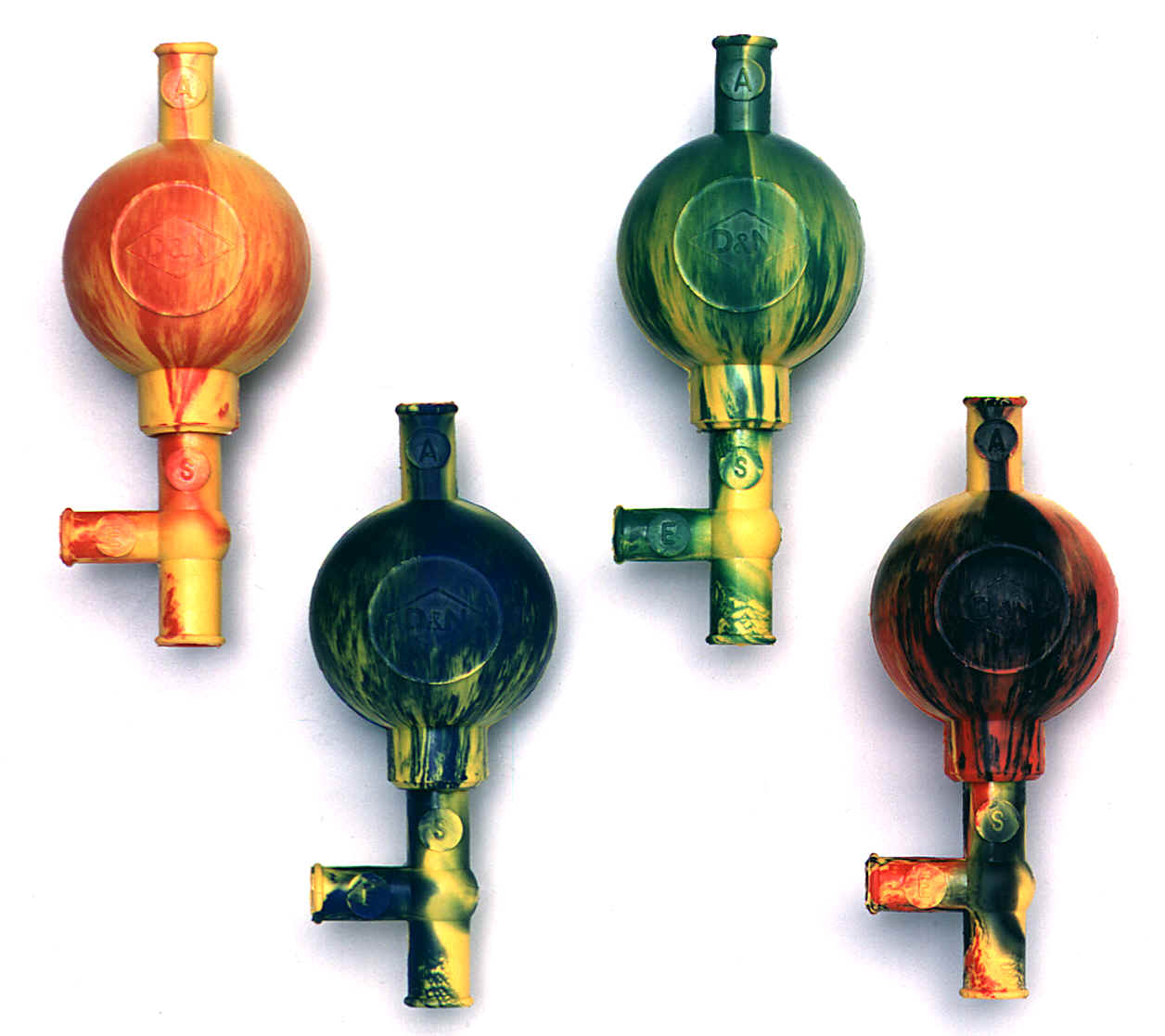 Multi-colored Natural Rubber Pipette filler - These pipette fillers share the same design and recommended applications as the standard three valve natural rubber pipette fillers with one obvious difference. Laboratory technicians, like many specialized professionals, often have unique and creative personalities. Why shouldn't their equipment reflect that? Many use colors that match their alma matter or favorite sports team. These bulbs are available in four different color combinations and have a "tye dye" appearance. Item number is MULTIPIP.
 FLIP Style Natural Rubber Pipette Fillers - These pipette fillers are recommended for the same applications as the other natural rubber bulbs but have one significant design change. Instead of a manual valve at the top, which is used to remove the air from the bulb before drawing liquid, the patented "FLIP" model has an automatic valve at the top allowing for users to operate a pipette with one hand. This valve also can be removed to clean out the bulb if contaminants happen to find their way into the bulb. This version is new to the market in the past 20 years or so, ergo not as widely used, but the technology is more advanced than on the standard bulb. Note: Fischer Technical Company is the only wholesale distributor authorized to sell these in the US and we offer them through a variety of distributors. Contact me if you need to find an authorized dealer at JGura@fischertech.com. These are available in Red, Black, Blue, Green, and Yellow. Item numbers are FLIP-001, FLIP-002, FLIP-003, FLIP-004, and FLIP-005.
 Silicone Three Valve Pipette Fillers - We also offer Red and Black pipette fillers, designed similar to our standard three valve pipette fillers, made with silicone rubber as opposed to natural rubber. These bulbs are ideal for pipetting solutions which react with natural rubber, either via direct contact with the liquid or from the fumes. We do not recommend using these, or any of our bulbs, in applications where the solution will come in direct contact with the pipette filler. These are also available from our wide network of authorized dealers. The item numbers are SILBLK-001 and SILRED-001.
All of our pipette bulbs can draw up to 50ml of liquid and can be used with pipettes up to 100ml. Note, for pipettes larger than 50ml, users are required to draw the liquid twice due to the 50ml capacity.
I hope this information is helpful in helping you choose the proper pipette filler for your application. Please do not hesitate to contact me with any questions at JGura@fischertech.com
Happy Pipetting!
Friday, May 13, 2011
Top Ten Ways to Encourage Young Scientists Over Summer Break
As we fast approach the end of the school year, I'm looking at different educational science activities that my children can take part in over the summer. I've narrowed it down to my ten favorites:
10. The easiest place to start is right in your own backyard. Give children a bug catcher, a magnifying glass, or simply a pencil and paper. Ask them to search the yard and see who and what lives there? Take it further and have them check different locations (ie at a grandparents house, lake cabin, friends yard, etc). Encourage the children to figure out what factors lead to the organisms living in a particular environment.
9. Take a Nature Walk. There are so many walking paths and trails in the US that are underutilized by families for educational purposes. To this day, I still hear from my kids about the beaver they saw building a damn when they took a nature walk in their preschool. This is a great way to learn about an animals habitat.
8. Go outside and look up! On a clear night, there are so much in the sky to see. Having a telescope makes this even more educational and valuable. Even without one, we can still see quite a bit. Don't be afraid to use the internet to see when and where planets will be visible.
7. Go to a museum. This should go without saying, but depending on the age of the children, one can visit any good museum multiple times and always find new things they didn't get to see on a previous trip. As far as Chicago goes, my kids really love the Museum of Science and Industry.
6. Take them to the Zoo! Large and small, all zoos offer so many opportunities to learn and kids absolutely love going to a zoo.
5. Utilize the programs offered by your local park districts. Many park districts offer events ranging from reptile interactions to butterfly hunts to lessons about dinosaurs and fossils. These are sure fire hits with kids.
4. Start a rock collection. Have kids collect as many different types of rocks (or seashells depending on where you live) and see how many they can identify. There are many great posters out there that can help identify rocks, minerals, or seashells. A quick search on the internet will help you find one. Note: our principal, Feenixx Publishing produces the finest ones I've seen. Email me at JGura@fischertech.com and I can refer you to a distributor.
3. Backyard Bird Identification. This is another activity that could be significantly aided by a Backyard Bird poster which again is easily found with a quick web search. Again, I highly recommend the posters from Feenixx Publishing. You'd be amazed how many different types of birds visit your neighborhood.
2. Blow Something up.....safely. I highly encourage this to be done outdoors. Taking care not to get their face in the way, drop a few Mentos into a two liter bottle of diet coke (don't use regular coke unless you want the sugar to stick to everything). I've seen a great products on the internet that attach to the top of a soda bottle and allow a string to be pulled which safely releases the Mentos into the soda. You'll be amazed at how high the soda flies. Ask your kids to explain scientifically why this happened.
1. My personal favorite science activity is taking my kids to an amusement park. If your kids are younger, start out with simpler questions for them to find out, such as why a ride has a height restriction. Older kids can really dissect a park through physics by calculating speed, acceleration, centrifugal and centripetal forces, height, friction, etc. There is always a smile on my face when my 6 year old explains to his younger brother why people don't fall out of roller coasters that go upside down!
Please share your ideas for additional activities and adventures to help us mold the future scientists of the world. Need motivation....just remind yourself that the kids of today will be our caretakers of tomorrow!
10. The easiest place to start is right in your own backyard. Give children a bug catcher, a magnifying glass, or simply a pencil and paper. Ask them to search the yard and see who and what lives there? Take it further and have them check different locations (ie at a grandparents house, lake cabin, friends yard, etc). Encourage the children to figure out what factors lead to the organisms living in a particular environment.
9. Take a Nature Walk. There are so many walking paths and trails in the US that are underutilized by families for educational purposes. To this day, I still hear from my kids about the beaver they saw building a damn when they took a nature walk in their preschool. This is a great way to learn about an animals habitat.
8. Go outside and look up! On a clear night, there are so much in the sky to see. Having a telescope makes this even more educational and valuable. Even without one, we can still see quite a bit. Don't be afraid to use the internet to see when and where planets will be visible.
7. Go to a museum. This should go without saying, but depending on the age of the children, one can visit any good museum multiple times and always find new things they didn't get to see on a previous trip. As far as Chicago goes, my kids really love the Museum of Science and Industry.
6. Take them to the Zoo! Large and small, all zoos offer so many opportunities to learn and kids absolutely love going to a zoo.
5. Utilize the programs offered by your local park districts. Many park districts offer events ranging from reptile interactions to butterfly hunts to lessons about dinosaurs and fossils. These are sure fire hits with kids.
4. Start a rock collection. Have kids collect as many different types of rocks (or seashells depending on where you live) and see how many they can identify. There are many great posters out there that can help identify rocks, minerals, or seashells. A quick search on the internet will help you find one. Note: our principal, Feenixx Publishing produces the finest ones I've seen. Email me at JGura@fischertech.com and I can refer you to a distributor.
3. Backyard Bird Identification. This is another activity that could be significantly aided by a Backyard Bird poster which again is easily found with a quick web search. Again, I highly recommend the posters from Feenixx Publishing. You'd be amazed how many different types of birds visit your neighborhood.
2. Blow Something up.....safely. I highly encourage this to be done outdoors. Taking care not to get their face in the way, drop a few Mentos into a two liter bottle of diet coke (don't use regular coke unless you want the sugar to stick to everything). I've seen a great products on the internet that attach to the top of a soda bottle and allow a string to be pulled which safely releases the Mentos into the soda. You'll be amazed at how high the soda flies. Ask your kids to explain scientifically why this happened.
1. My personal favorite science activity is taking my kids to an amusement park. If your kids are younger, start out with simpler questions for them to find out, such as why a ride has a height restriction. Older kids can really dissect a park through physics by calculating speed, acceleration, centrifugal and centripetal forces, height, friction, etc. There is always a smile on my face when my 6 year old explains to his younger brother why people don't fall out of roller coasters that go upside down!
Please share your ideas for additional activities and adventures to help us mold the future scientists of the world. Need motivation....just remind yourself that the kids of today will be our caretakers of tomorrow!
Tuesday, May 3, 2011
Top 5 Experiments Using a High Vacuum Pump

We've been successfully supplying our LAV-3 model high vacuum pump to science education dealers now for well over 20 years. Teachers always ask what is the best and most vivid experiments they can do in their classrooms to teach physics with our pump.
Of course, to get started, you'll need a vacuum pump (I highly recommend the LAV-3 or the LAV-3/G model from Fischer Technical, which can be purchased from your regular science education dealer), high vacuum tubing, a vacuum pump plate, and a good quality bell jar.
5. Shaving Cream Expansion - Put a little dab (technical term) of shaving cream inside your bell jar (which is then sealed onto the pump plate), turn the pump on and watch the molecules spread themselves out and the Shaving Cream grows! Be careful not to let it run too much where you pull the Creme into the vacuum pump though!
4. Grow a Balloon - place a balloon, filled a little bit and tied off inside your bell jar and turn the pump on. Students will be curious as to why the balloon expanded while the air is pulled from the chamber.
3. Springtime (Easter) Peep Monster - place one of those terribly unhealthy, yet tasty, sugar coated marshmallows, THE PEEP, inside your bell jar. Turn on the pump and watch your baby peep turn into a Stay Puft Marshmallow Man peep!
2. Did you hear a bell ringing? - place an electric bell or kitchen timer inside your chamber and turn on the pump. Make sure the bell is turned on! As the air molecules are pulled from the chamber, the sound will slowly disappear until it is gone! Great way to explain to students why an astronaut would never be heard if he were to start screaming while in outer space.
1. Cool Boiling Water - My all time favorite. It is absolutely critical that your pump is a "high vacuum" pump and not just a vacuum pump. You'll need to pull a much higher vacuum than the 25" of mercury some pumps offer to do this. Place a plastic bottle or petri dish in the chamber filled about half way up with water. Demonstrate to your students that the water is at room temperature and not hot to the touch. Put it in the vacuum chamber, turn on the pump, and in no time you'll have room temperature water simmering at a rapid boil. What better way to explain the effects on vapor points in different atmospheric pressure?
You can do a quick search on the internet and find all of these supplies from virtually every science education dealer....make sure to look for "Fischer Technical Brand". One tip, keep an eye on your vacuum pump oil level and drain and change any contaminated oil. Be sure to use "High Vacuum Pump Oil" as standard vacuum oil or other "home remedy" solutions (See: motor oil, vegetable oil, etc) will not allow the pump to continue operating properly!
Happy Teacher Appreciation week and good luck molding future physicists!
Friday, April 22, 2011
Break the Habit and Be a Hero

In today's economy, we all face the same question in nearly every business:
How can I do what I do at a lower cost to myself or my employer without sacrificing quality?
I see several instances of this all them time. As a manufacturer's rep in the Science Education market, there has clearly been an increase in business to the community colleges, particularly in the higher end products such as the Denoyer-Geppert
Anatomy models. I directly attribute this to a large increase of students entering college doing their general education studies at the local community college before moving on to a University for their 3rd year and beyond.
While on business travel, many of my colleagues are opting for less expensive lodging or smaller rental cars. I have noticed myself doing this.
But as a professional scientist in an industrial research laboratory or clinical research laboratory, how can you save your company significant money? The answer is simple in my mind.....BREAK THE HABIT.
I've been traveling around the country for about 10 years now and the most common answer I hear when asked why customers tend to purchase established name brands, specifically in pipettors and glassware is: "I've always used this brand". I imagine ten to twenty years ago, there was a substantial drop off in quality going from established brands to "economy lines". The times have changed.
For example, the line of Class A Glassware from United Scientific
is now used throughout the world in research and pharmaceutical labs. European quality demands are typically even higher than here in the USA! United has been supplying Industrial/Research supply dealers with micropipettes for about eight years now. I'd offer the quality of these pipettors up against any other pipettor in the market, yet labs still pay double and sometimes triple for brands they know.
My call to action this week is for all lab professionals to BREAK THE HABIT of always buying within your comfort zone and BE A HERO to your accounting department and top brass. Imagine the praise and honor to be bestowed on an employee who is able to cut a substantial portion of their lab expenses.
Please contact me at JGura@Fischertech.com if you'd like more information or for a dealer near you who carries these types of money saving products!
Have a great weekend,
John
Monday, April 18, 2011
Why have Parents do the student's work?
For the second year in a row, my 6 year old was asked to write a book for school. This included an "about the author" page, "dedication" and a typed, cut, and pasted story. For the second year in a row, we had the same result: My wife was able to practice writing children's books.
It seems that too often, especially in our younger classrooms, students are being asked to do projects that they clearly must have the parents complete. We're very proud of our boys and how well they do in school, but I have to be honest, I have not begun working with him on how to adjust margins, format text, change font, etc in Microsoft Word quite yet. Aside from a few illustrations, this project is completed by the parents for virtually every student and i must ask why?
There are several projects, particularly those in the science field, that students can conduct themselves. Children in elementary school are so easy to attract to learning, its almost heartbreaking to me as a parent when valuable time is wasted when real learning can take place.
On the other hand, my boys' classrooms have been following the web cam of the bald eagle family in Iowa. They have both come home asking questions and telling me all sorts of great facts about the eagle's habitat and diet. My first grader also learned about liquid's and solid's in his classroom and is very happy to point out examples throughout the day....this is what I mean by real learning.
Many of the companies I represent, specifically United Scientific and Culture Media & Supplies, offer hands on products to allow the students to learn at their own pace either in the science fair setting or in the classroom setting. Teaching young students how to create an electrical circuit, how a light switch works, or what items around the house grow bacteria can enhance interest and skills in our students.
My first grader's teacher gives her students a few minutes at the beginning of the day to write in their journals about anything they wanted. This has proven to be extremely valuable. At the beginning of the year, he was writing 4-6 words a day and usually the same thing "I like pugs, they are cool". Over spring break I was in utter amazement as I was reading coherent and literate 3-4 page entries detailing a special day, a special friend, a vacation, etc. He has learned so much from this......and he did it all by himself without mom and dad writing it for him!
Have a great week everyone!
It seems that too often, especially in our younger classrooms, students are being asked to do projects that they clearly must have the parents complete. We're very proud of our boys and how well they do in school, but I have to be honest, I have not begun working with him on how to adjust margins, format text, change font, etc in Microsoft Word quite yet. Aside from a few illustrations, this project is completed by the parents for virtually every student and i must ask why?
There are several projects, particularly those in the science field, that students can conduct themselves. Children in elementary school are so easy to attract to learning, its almost heartbreaking to me as a parent when valuable time is wasted when real learning can take place.
On the other hand, my boys' classrooms have been following the web cam of the bald eagle family in Iowa. They have both come home asking questions and telling me all sorts of great facts about the eagle's habitat and diet. My first grader also learned about liquid's and solid's in his classroom and is very happy to point out examples throughout the day....this is what I mean by real learning.
Many of the companies I represent, specifically United Scientific and Culture Media & Supplies, offer hands on products to allow the students to learn at their own pace either in the science fair setting or in the classroom setting. Teaching young students how to create an electrical circuit, how a light switch works, or what items around the house grow bacteria can enhance interest and skills in our students.
My first grader's teacher gives her students a few minutes at the beginning of the day to write in their journals about anything they wanted. This has proven to be extremely valuable. At the beginning of the year, he was writing 4-6 words a day and usually the same thing "I like pugs, they are cool". Over spring break I was in utter amazement as I was reading coherent and literate 3-4 page entries detailing a special day, a special friend, a vacation, etc. He has learned so much from this......and he did it all by himself without mom and dad writing it for him!
Have a great week everyone!
Friday, April 15, 2011
United Scientific Industrial/Research Supplies

For over 25 years, United Scientific has been successfully supplying the science education market with top quality, value driven science education supplies and teaching apparatus. Did you know that for the past 10 years, United Scientific has been growing their line of industrial/research products?
United offers a full line of laboratory plasticware. Economically priced to save your customers significant budget dollars compared to the "name brands", United stocks PMP, PP, and HDPE plasticware. Successfully sold for nearly ten years, our beakers, cylinders, bottles, test tube racks, drying racks, funnels, etc are in stock and ready to be shipped to your customer. Put a smile on their face and keep a few bucks in their pockets!
Our full line of liquid handling, including fixed volume micropipettes, variable volume micropipettes, multichannel micropipettes, mini pipettes, and bottle top dispensers have been growing in sales exponentially over the past 7 years. You won't find a better value for this type of quality. Our line of micropipettes are used throughout the world in classrooms as well as pharmaceutical labs!
New in 2010 was the completion of our laboratory glassware line. United now carries Class A and Class B borosilicate glassware. Our line of Class A is available in both serialized and batch certified (certificates included with every order). United offers beakers, cylinders, flasks, volumetric flasks, boiling flasks, media bottles, and much, much more! The dealer costs are a fraction of what the known industry leaders are charging and the quality is top notch. Our glassware is manufactured in an ISO 9001 facility and can be found in Pharma labs all over the world.
Aside from just plastic, glass, and pipettes, United has an extensive line of laboratory hardware and supplies. The lab coats are the finest quality I've seen that is even remotely close in price to anything on the market. If you're looking for "low hanging fruit" as we say in the sales business, this is it. Check out the united scientific catalog to see the full line of clamps, rods/bases, porcelain ware, aprons, spatulas, tongs, etc.
Please contact me if you need additional copies of our dealer catalog and price list. Digital images are available, just let me know.
We've seen United's industrial and research market share grow significantly over the past few years and we'd like you to be a part of it!
Have a great weekend!
John
Subscribe to:
Posts (Atom)